Posted by Thane
September 7, 2010
About a half an hours dolmus ride from Selçuk is a small village where the locals purchase most their needs for the week. We were told that in Tire (pronounced Tee-ray) we would find most women in traditional dress and very few tourists. We started to see this as we rode the dolmus out of town and stopped at each small settlement along the way to pick up Tuesday shoppers.
We wandered off into the congested, covered streets to find everything from clothing, fruits and vegetables, lace and dry goods to the donkey saddle maker.
Melissa found it hard to not purchase something with so many beautiful things available. But if we buy anything, we have to eliminate something else in our already stuffed backpacks. If we can't eat it, drink it or store it digitally we probably just have to look.
While some of the local shoppers rested their feet,
we stopped by the one of the many old Mosques in town for a respite from the crowds and noise.
We strolled past the men having tea and discussions outside the Mosque and wandered down little back streets with beautiful colors on our way back to the dolmus stand for our ride back to Selçuk.
We stayed a couple more days in Selçuk enjoying the town and going to the beach.
Next up: Pamukkale, a Unesco World Heritage Site with hot springs, travertine pools and the Sacred Pool at Hierapolis.
Saturday, October 23, 2010
Friday, October 22, 2010
Şirince: Ottoman houses, Cobblestone streets & Wine
Posted by Thane and Melissa - a joint effort this time.
September 11, 2010
This lovely morning we headed out for a little excursion to Şirince (pronounced shi RIN jay), a small hilltown above Selcuk. We rode a packed dolmus (14 passenger van/bus) up the narrow road, switchbacking it's way up steep, dry canyons dotted with vineyards, olive groves and peach orchards.
This little village traces it's roots to about 1,000 BC when Greeks started building settlements in the area. It was inhabited by Greeks until a population exchange in 1922 when most Greeks living in Turkey were "relocated" to Greece and Turks living in Greece "relocated" to Turkey. Today it is a picturesque village with views of the valley below.
The architecture is Ottoman Greek and is protected by an historic district regulation. The houses have changed little for centuries. Many are dilapidated and cannot be remodeled without going though extensive applications.
Bring your walking shoes if you want to check out this little village, the cobblestone streets are steep and uneven - built to handle donkey carts. We especially enjoyed exploring the back streets, away from shopping and crowds. Although several little grannies did shout at us and tried to get us to go into their houses to look at their handcrafts. Since we are traveling for seven months with a backpack each, we have to stick with photos, memories, or food as souvenirs, so we passed on their kind (pushy) offers.
We didn't think about it before heading up the hill, but today was the 2nd day of Bayram, a three day celebration at the end of Ramizan (Turkish Ramidan). With perfect weather and a holiday, the town was filled with Turks on vacation. We were so thankful that we had taken a bus and did not have to find a spot to park a car off the edge of the road somewhere as so many tourists were attempting! We had a great time despite the crowd, wondering the busy little lanes.
We sat down to eat at this outdoor cafe where the gozleme (often described as a Turkish pancake or crepe) was freshly baked on a wood fire.
Melissa had a spinach one with Ayran (a yogurt drink) while Thane chose the meat and cheese with Turkish tea.
We shared a table with a family from Kusadasi. The Dad was a Principal at a K-12 private school and the Mom was an English teacher which was very helpful. We enjoyed chatting over lunch about our different cultures.
We came upon several women dressed in village dress selling freshly baked bread. This bread was on it's way to the oven.
It came in all different sizes and shapes and appeared to have been baked in whatever container they could recycle. We picked up a very hefty loaf (3-4 pounds) from this sweet lady. It was tough getting it home without eating it as the smell was amazing but we had promised to bring a loaf for our lunch at Adem and Sheryl's the next day. It turned out to BE amazing - much moister and heavier than the typical lightweight, fluffy white bread that is ubiquitous in Turkey. That's our loaf, wrapped in white paper!
Oh, must not forget the wine. Although vineyards have been tended in Turkey since 4,000 BC, Turks are not known for their wine. There is a reason folks... it's just not that good. That might be because wine consumption was prohibited for about 500 years under the Ottoman Empire. Little Şirince now has a reputation as a wine town and it certainly has plenty. Much of it is sweet, syrupy stuff made from various fruits such as peach, cherry, strawberry, raspberry, kiwi, melon, and blackcurrants. We stopped in and tasted a few and somehow got caught up in the moment and purchased a bottle. We enjoyed drinking it as an aperitif and somehow, by the time we left Selçuk several days later, that wine bottle was empty!
Misc. pics from our day in Şirince.
Next up a visit to Tire (prounounced tea ray) a little, non tourist town for a big market day.
September 11, 2010
This lovely morning we headed out for a little excursion to Şirince (pronounced shi RIN jay), a small hilltown above Selcuk. We rode a packed dolmus (14 passenger van/bus) up the narrow road, switchbacking it's way up steep, dry canyons dotted with vineyards, olive groves and peach orchards.
This little village traces it's roots to about 1,000 BC when Greeks started building settlements in the area. It was inhabited by Greeks until a population exchange in 1922 when most Greeks living in Turkey were "relocated" to Greece and Turks living in Greece "relocated" to Turkey. Today it is a picturesque village with views of the valley below.
The architecture is Ottoman Greek and is protected by an historic district regulation. The houses have changed little for centuries. Many are dilapidated and cannot be remodeled without going though extensive applications.
Bring your walking shoes if you want to check out this little village, the cobblestone streets are steep and uneven - built to handle donkey carts. We especially enjoyed exploring the back streets, away from shopping and crowds. Although several little grannies did shout at us and tried to get us to go into their houses to look at their handcrafts. Since we are traveling for seven months with a backpack each, we have to stick with photos, memories, or food as souvenirs, so we passed on their kind (pushy) offers.
We didn't think about it before heading up the hill, but today was the 2nd day of Bayram, a three day celebration at the end of Ramizan (Turkish Ramidan). With perfect weather and a holiday, the town was filled with Turks on vacation. We were so thankful that we had taken a bus and did not have to find a spot to park a car off the edge of the road somewhere as so many tourists were attempting! We had a great time despite the crowd, wondering the busy little lanes.
We sat down to eat at this outdoor cafe where the gozleme (often described as a Turkish pancake or crepe) was freshly baked on a wood fire.
Melissa had a spinach one with Ayran (a yogurt drink) while Thane chose the meat and cheese with Turkish tea.
We shared a table with a family from Kusadasi. The Dad was a Principal at a K-12 private school and the Mom was an English teacher which was very helpful. We enjoyed chatting over lunch about our different cultures.
We came upon several women dressed in village dress selling freshly baked bread. This bread was on it's way to the oven.
It came in all different sizes and shapes and appeared to have been baked in whatever container they could recycle. We picked up a very hefty loaf (3-4 pounds) from this sweet lady. It was tough getting it home without eating it as the smell was amazing but we had promised to bring a loaf for our lunch at Adem and Sheryl's the next day. It turned out to BE amazing - much moister and heavier than the typical lightweight, fluffy white bread that is ubiquitous in Turkey. That's our loaf, wrapped in white paper!
Oh, must not forget the wine. Although vineyards have been tended in Turkey since 4,000 BC, Turks are not known for their wine. There is a reason folks... it's just not that good. That might be because wine consumption was prohibited for about 500 years under the Ottoman Empire. Little Şirince now has a reputation as a wine town and it certainly has plenty. Much of it is sweet, syrupy stuff made from various fruits such as peach, cherry, strawberry, raspberry, kiwi, melon, and blackcurrants. We stopped in and tasted a few and somehow got caught up in the moment and purchased a bottle. We enjoyed drinking it as an aperitif and somehow, by the time we left Selçuk several days later, that wine bottle was empty!
![]() |
| I didn't take this - pulled it from the web - http://www.homedecorators.com |
| Dried peppers and mushrooms |
| Motorcycle with sidecar - just the right size for local roads! |
| Sunflowers |
| Squash or melons |
Next up a visit to Tire (prounounced tea ray) a little, non tourist town for a big market day.
Friday, October 15, 2010
Ephesus and our FIFTH Wonder of the Ancient World
Posted by Melissa
September 9, 2010
Our tour of Ephesus began early in the morning with a drive up the hill above the ruined city of Ephesus, through the pine trees to the hidden Meryemana, The House of the Virgin Mary. This is the hideaway where St. Paul brought Mary to after Jesus died. It was a really amazing place to visit and I was taken by surprise at the deep response I had to being here.
Despite the parking lot full of tour buses, I found myself alone inside this house. With the soft music playing in the background and contemplating who had lived here, I was very moved. It boggled my mind to think that I was standing in the house of the woman who, in a way, was the origin of the Christian religion. She walked here, ate here, drew her water from a spring here, and died here. The sense of peace was powerful and I had a hard time tearing myself away from here.
I found it interesting that this is also a sacred site for Muslims who honor Mary as the mother of the Prophet Jesus and believe in the virgin birth.
These candles were located just outside the house. I lit one and said a prayer for my loved ones and for peace throughout the world. Every little bit helps!
After a quiet exploration of Mary's house, we headed to the main ruins at Ephesus. Ephesus is reportedly the best preserved classical city of the Eastern Mediterranean. The oldest settlements in the area are from the 5th to 3rd millennia BC. That is 3,000 to 5,000 years BEFORE Christ. Amazing. Most of what we saw was from the period called Ephesus III built around the 1st to 3rd centuries AD. This city had about 250,000 occupants.
This marble street was a main city boulevard, lined with statues and small shops and inns - including the requisite brothel.
Another shot of the same street. I thought the crowds actually helped me to get a sense of what it may have felt like when it was a busy commercial center.
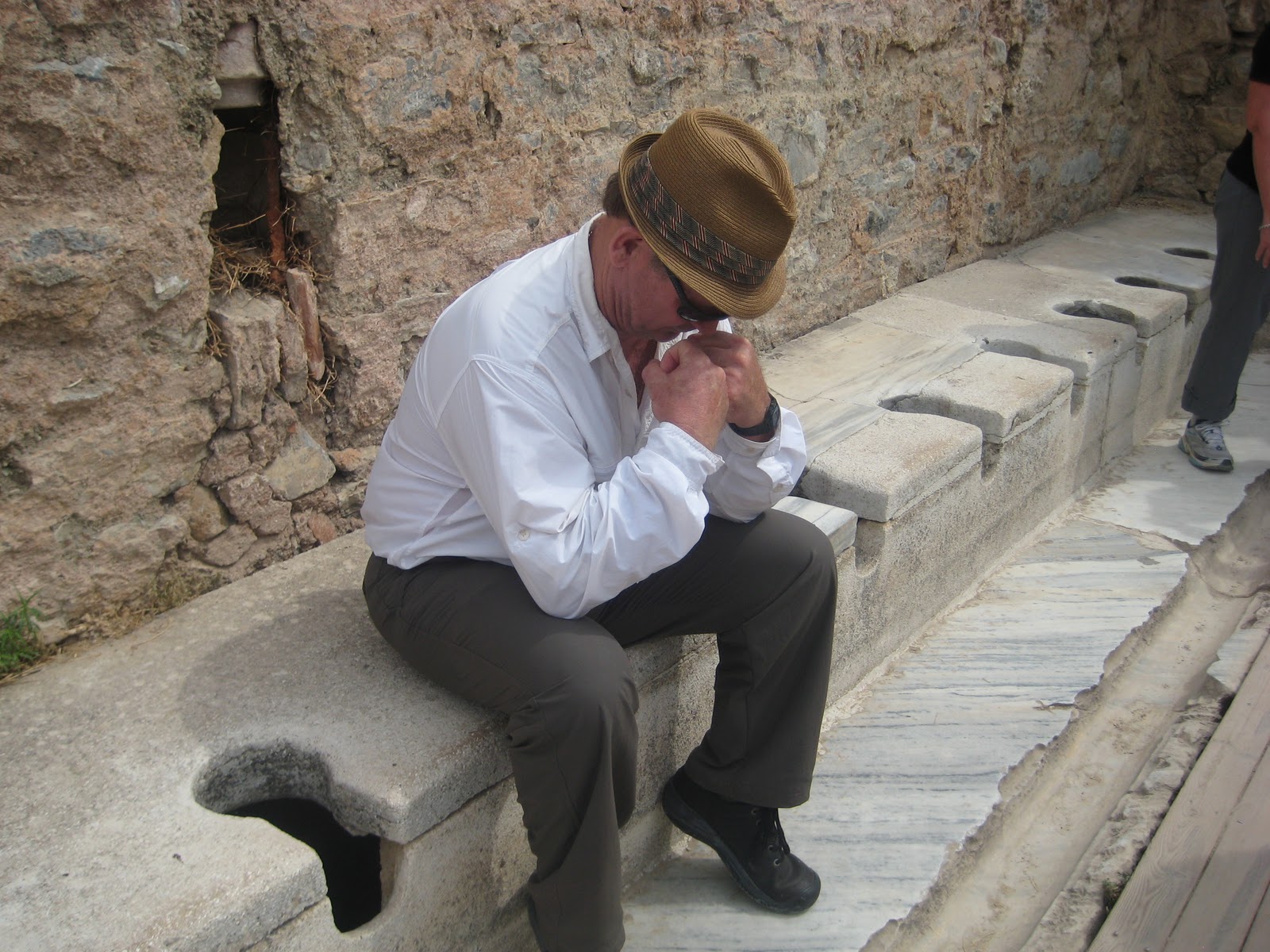
The public toilet, built in the 1st century AD, was an amazing place. It is a very large room lined with toilets seats. There is a channel running below the seats that held running water. Our guide told us that rich merchants and politicians had slaves to sit on the marble toilet seats to pre-warm them as needed. Oh, sorry Thane, looks like you are a bit busy there...
The terrace houses, located off the main street, were the homes of the elite and wealthy. These homes were amazing with their frescoed walls and mosaic floors. They were generally two story homes with hot and cold running water and central heating! Each house also had it's own well in a central courtyard, for use when the city plumbing was not working. The light in these pics is a bit off as this whole area is covered by a protective roof.
Check out the pipe at the bottom of the doorway. These houses had piping for cold water, hot water, and heated air!
We walked on these glass walkways throughout the terrace houses. They were great because we could see everything through them without damaging anything - but a couple of times they were quite high up and I DIDN'T like that at all!
The Celsus Library was one of the largest libraries of the ancient world, holding about 12-15,000 scrolls.
The theater is the largest structure at Ephesus. It was constructed in the 3rd century BC and could hold 25,000 people!
Leave it to Thane to notice this pile of clay pipes. They were stacked along side the path and looked like a pile of current construction materials. We asked, just in case, and amazingly found out that these are ORIGINAL pieces of plumbing from the city.
Misc. pics from our day ...
Well you made it this far and I think it's about time I get to another of the Seven Wonders of the Ancient World. We've already taken you to The Great Pyramid of Giza, the only one of the seven wonders still standing. We've also already visited the sites of the Mausoleum of Maussollos at Halicarnasus, The Colossus of Rhodes, and the Lighthouse of Alexandria. I shan't make you wait any longer. Here is Ancient Wonder #5 - The Temple of Artemis at Ephesus. Drum roll please.....
Is that all there is you ask? Why of course not silly! There is also this:
Sadly, this is about all that remains of this Ancient Wonder after earthquakes, fire, and looting by Goths.
OK - the following couple of pics may be considered X rated. If that is a problem - then please wave goodby until our next post ......
Up next was the Ephesus Museum in Selcuk. It was filled with lovely statuary, glassware and numerous artifacts. But of course, the most photographed is this little guy Priapus. He was found in a well outside the brothel. I bet you'd never guess that he is a fertility god!
This guy is Priapus' neighbor at the museum. Also a fertility god, note the large basket of fruit held up by his broken, but still erect body part.
Well, with those visions in your head, I bid you adieu until next time when we visit the little villages of Şirince and Tire.
September 9, 2010
Our tour of Ephesus began early in the morning with a drive up the hill above the ruined city of Ephesus, through the pine trees to the hidden Meryemana, The House of the Virgin Mary. This is the hideaway where St. Paul brought Mary to after Jesus died. It was a really amazing place to visit and I was taken by surprise at the deep response I had to being here.
Despite the parking lot full of tour buses, I found myself alone inside this house. With the soft music playing in the background and contemplating who had lived here, I was very moved. It boggled my mind to think that I was standing in the house of the woman who, in a way, was the origin of the Christian religion. She walked here, ate here, drew her water from a spring here, and died here. The sense of peace was powerful and I had a hard time tearing myself away from here.
I found it interesting that this is also a sacred site for Muslims who honor Mary as the mother of the Prophet Jesus and believe in the virgin birth.
These candles were located just outside the house. I lit one and said a prayer for my loved ones and for peace throughout the world. Every little bit helps!
After a quiet exploration of Mary's house, we headed to the main ruins at Ephesus. Ephesus is reportedly the best preserved classical city of the Eastern Mediterranean. The oldest settlements in the area are from the 5th to 3rd millennia BC. That is 3,000 to 5,000 years BEFORE Christ. Amazing. Most of what we saw was from the period called Ephesus III built around the 1st to 3rd centuries AD. This city had about 250,000 occupants.
This marble street was a main city boulevard, lined with statues and small shops and inns - including the requisite brothel.
Another shot of the same street. I thought the crowds actually helped me to get a sense of what it may have felt like when it was a busy commercial center.
The public toilet, built in the 1st century AD, was an amazing place. It is a very large room lined with toilets seats. There is a channel running below the seats that held running water. Our guide told us that rich merchants and politicians had slaves to sit on the marble toilet seats to pre-warm them as needed. Oh, sorry Thane, looks like you are a bit busy there...
The terrace houses, located off the main street, were the homes of the elite and wealthy. These homes were amazing with their frescoed walls and mosaic floors. They were generally two story homes with hot and cold running water and central heating! Each house also had it's own well in a central courtyard, for use when the city plumbing was not working. The light in these pics is a bit off as this whole area is covered by a protective roof.
Check out the pipe at the bottom of the doorway. These houses had piping for cold water, hot water, and heated air!
| stone tile floor mosaic |
| another stone tile floor mosaic |
The Celsus Library was one of the largest libraries of the ancient world, holding about 12-15,000 scrolls.
The theater is the largest structure at Ephesus. It was constructed in the 3rd century BC and could hold 25,000 people!
Leave it to Thane to notice this pile of clay pipes. They were stacked along side the path and looked like a pile of current construction materials. We asked, just in case, and amazingly found out that these are ORIGINAL pieces of plumbing from the city.
| Ancient clay plumbing stacked in front of the Odeon |
| Winged Nike, Goddess of Victory |
| Another shot of the Celsius Library |
| Temple of Hadrian |
| Small detail from a fountain |
Is that all there is you ask? Why of course not silly! There is also this:
Sadly, this is about all that remains of this Ancient Wonder after earthquakes, fire, and looting by Goths.
OK - the following couple of pics may be considered X rated. If that is a problem - then please wave goodby until our next post ......
Up next was the Ephesus Museum in Selcuk. It was filled with lovely statuary, glassware and numerous artifacts. But of course, the most photographed is this little guy Priapus. He was found in a well outside the brothel. I bet you'd never guess that he is a fertility god!
This guy is Priapus' neighbor at the museum. Also a fertility god, note the large basket of fruit held up by his broken, but still erect body part.
Well, with those visions in your head, I bid you adieu until next time when we visit the little villages of Şirince and Tire.
Subscribe to:
Posts (Atom)